
Kathryn Franks
Art 150
Slow Design Principles Applied to Other Artists
One such example of the use of design principles is right in our own backyard, so-to-speak. James Turrell – an artist known for using the medium of light to allow the viewer to explore the surrounding sky, land, and culture built the UIC Skyspace which resides on the corner of Roosevelt and Halstead. The Skyspace, along with many other of Turrell’s works, is an example of Principle 1: REVEAL and Principle 2: EXPAND.
Principle 1: REVEAL – Skyspace, best viewed at either sunrise or sunset in which the sky blends together with the center dome of the sculpture and creates a beautiful light ambiance. Turrell stated that Skyspace, “deals with light itself, not as the bearer of revelation, but as revelation itself.” Turrell, through the use of Skyspace is revealing to the viewer the common events they may miss when it comes to everyday life. By experiencing Skyspace, the viewer has a chance to sit down, reflect, and witness the celestial wonders that occur without fail everyday. Benches and a curtain of water also allow the viewer to become closed off and segregated from the distractions of the outside world. The curtain of water is there to relax the viewer and to offer shelter from the outside pedestrian and vehicular traffic while the benches allow the viewer to experience Skyspace for long periods of time.
Principle 2: EXPAND – each experience with Skyspace will be unique – since no sunrise or sunset is exactly the same. Over time, the viewer will be able to see the different colors, shapes, and shadows that cross the dome as the sun either rises or sets. Over the course of a year, millions of different patterns and colors would be experienced by the viewer. Turrell states that by creating Skyspace, he wanted, “to create something that directly connects you to a thought that is wordless, a thought that doesn’t have a story line… It’s an arena of thought that has a kind of loneliness, but also a great beauty.” With Skyspace, the concept of time is distorted – there is no time at all – just merely reflection paired with the beauty of the atmosphere.


James Turrell’s other works are just as fascinating. His largest and most breathtaking is the Roden Crater. He states, “It is a volcanic crater located in an area of exposed geology, the Painted Desert, an area where you feel geologic time. You have a strong feeling of standing on the surface of the planet.” The crater has been outfitted with a series of tunnels, pathways, chambers and openings that reveal the sky from within and around the crater’s surface. The crater harnesses the dramatics of light, celestial events, and the landscape to disturb and awaken our senses and perceptions of the universe. It is a monument to human perception itself.


All information about James Turrell, interviews, biography, etc. was found on his website at: jamesturrell.com.
A global activist and environmental art pioneer by the name of Betsy Damon creates flowing, artistic public waterways that clean water sources and raise awareness for the cause. Her work has been featured in places such as the US, specifically Oregon, and as far away as the province of Chengdu, China. She has a non-profit organization, Keepers of the Waters, which helps to provide information and technical support to those who wish to create projects like hers in their own communities. Her public displays are examples of both Principle 4: ENGAGE and Principle 5: PARTICIPATE.
Principle 4: ENGAGE – by installing her waterways, Damon is highlighting the interdependency of humans with a precious resource, water. She collaborates with local communities and residents to create the water pathways that are designed to both clean and guide water to specific sources. By installing these public sculptures, she teaches the communities on how to install their own water cleaning devices and how to care for their drinking water and/or hydrating resource for crops. In doing so, she also raises awareness of water contamination and pollution and how it affects communities across the globe.
Principle 5: PARTICIPATE – Damon states, “Global water quality is dependent on each community having a sustainable water source that they know about and are responsible for. Cities all over the planet can be filled with vibrant, water and art-filled community centers, parks, schoolyards businesses and backyards that help people become intimately connected to their water sources. These projects will lead the way for fully sustainable water infrastructures, visible and integrated into our everyday lives, rather than hidden under the ground.” By allowing citizens to actively participate in the cleaning of their own waterways and systems, it allows transparency and communication. No longer is the art of waterworks (such as canal systems, sewage, drainage, irrigation, etc.) a secret – it is made public for the betterment of lives. Poor communities benefit most, with access to clean water and proper irrigation systems, there are fewer victims of sickness and death.


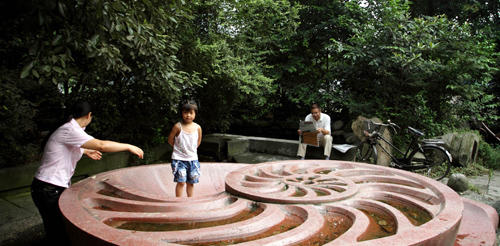


All information regarding Betsy Damon such as her interview and information about her non-profit organization was found on greenmuseum.org.